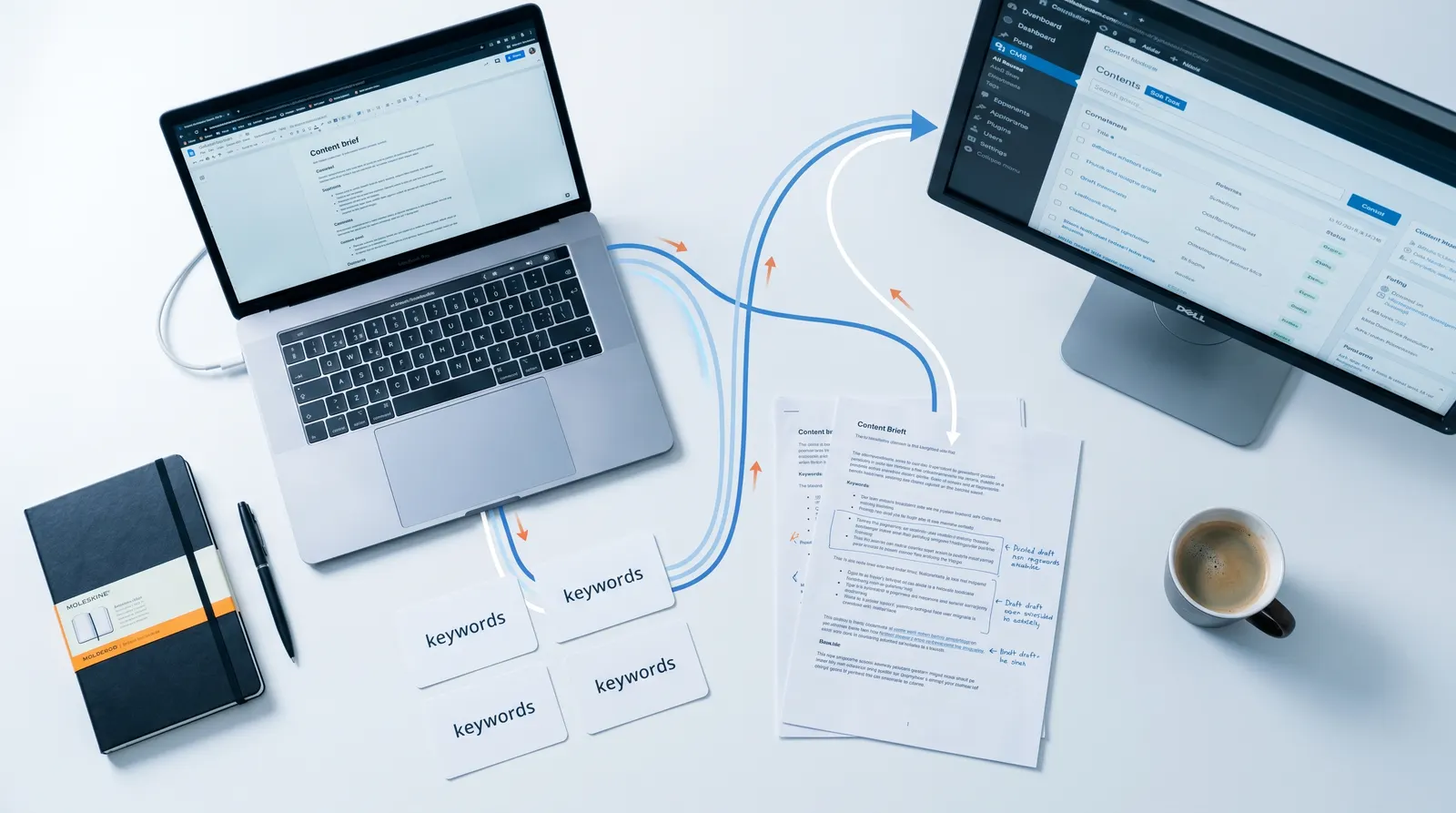
Most SEO teams spend more time on content logistics than on actual content. Brief creation, keyword mapping, draft formatting, CMS uploads, meta tag entry, internal linking checks. None of that is creative work, and most of it can be automated.
Content automation for SEO is the practice of using AI and workflow tools to handle the repetitive parts of content production so you can focus on strategy and quality. Done right, it cuts production time dramatically without sacrificing the depth that Google and AI engines reward.
This guide covers four automation layers: briefs, drafting, content refresh, and publishing. Each section explains what to automate, what to keep manual, and which tools handle it well.
Why content automation matters now
Two things changed in 2025 that made content automation essential rather than optional.
First, AI search engines (ChatGPT, Perplexity, Google AI Overviews) raised the quality bar. These engines cite pages that answer questions directly, with clear structure and genuine expertise. Thin content that used to rank through keyword density doesn’t get cited. You need more depth per page, which means more production time per page.
Second, Google’s helpful content systems got better at detecting formulaic AI output. You can’t just generate 50 blog posts and publish them. Every page needs a human perspective, original examples, and real editorial judgment.
The result: you need higher quality AND higher volume. Automation is how you get both without doubling your team.
Layer 1: Automated content briefs
A content brief defines what a page should cover before anyone writes a word. Without automation, briefs take 30-60 minutes each. With it, you get a better brief in under 5 minutes.
What to automate
Keyword clustering and intent mapping. Feed your target keyword into a tool that pulls search volume, difficulty, SERP features, and related questions. Group keywords by intent so you know whether the page should educate, compare, or convert.
Competitor gap analysis. Pull the top 5 ranking pages for your target keyword. Extract their headings, topics covered, word counts, and schema types. Identify what they all cover (table stakes) and what none of them cover (your opportunity).
Question extraction. Scrape People Also Ask boxes, Reddit threads, and forum posts for real questions your audience asks about the topic. These become your H2s and FAQ sections.
Brief assembly. Combine all of the above into a structured document: target keyword, secondary keywords, search intent, recommended headings, questions to answer, competitor gaps, internal linking targets, and word count range.
What to keep manual
Editorial angle. A brief can tell you what topics to cover, but the strategic decision of how to position your brand’s perspective requires human judgment. Read the competitor content yourself and decide what’s missing, what’s wrong, and what your unique take is.
Tools that work
Fokal generates content briefs automatically by combining keyword research with SERP analysis and competitor gap detection. The brief includes internal linking suggestions from your existing content library.
For manual setups, combine Google Search Console data with a keyword tool and a SERP scraper. Feed the results into Claude or ChatGPT with a brief template prompt.
Layer 2: AI-assisted drafting
AI drafting is where most people start with content automation. It’s also where most people go wrong.
The mistake is using AI to write entire articles from a keyword. The result reads like every other AI article on the topic, Google’s systems are increasingly good at detecting it, and AI search engines have no reason to cite it because it adds nothing new.
The right approach: use AI to accelerate a human-driven process.
The draft workflow
Start with your brief, not a blank prompt. Feed your completed brief (from Layer 1) into your AI tool. The brief constrains the output so it covers the right topics at the right depth.
Write section by section. Don’t generate the whole article at once. Work through each H2 individually. For each section, give the AI your key points, data, and examples, then let it draft the prose. Edit as you go.
Inject original material. Every section needs at least one element the AI couldn’t have generated: a proprietary data point, a customer example, a specific tool recommendation based on your testing, or a contrarian take on conventional wisdom. This is what makes the page worth citing.
Match your brand voice. Feed the AI 2-3 examples of your published content and ask it to match the tone. Better yet, use a tool that stores your brand voice profile so every draft starts in the right register.
What AI drafting saves
The biggest time savings aren’t in the actual writing. They’re in:
- Outline expansion. Turning a 10-line brief into a structured draft skeleton with logical flow.
- Research synthesis. Summarizing competitor content, studies, and data into usable prose.
- Formatting. Adding proper heading hierarchy, bullet points, and transition sentences.
- First-draft iteration. Getting from blank page to “something I can edit” in minutes instead of hours.
A realistic expectation: AI-assisted drafting cuts writing time by 50-70%. The remaining time goes to editing, adding original insights, and quality control. That’s time well spent.
Layer 3: Content refresh automation
Publishing a page is not the end of the workflow. Pages decay. Competitors publish better content. Search intent shifts. Data goes stale. If you’re not refreshing content regularly, your rankings will erode.
Content refresh is the highest-ROI automation because it works with pages that already have authority, backlinks, and indexing history.
Setting up automated refresh triggers
Instead of manually auditing your content library every quarter, set up triggers that flag pages needing attention.
Performance-based triggers. Connect Google Search Console and set alerts for:
- Pages where average position has dropped by 3+ spots in 30 days
- Pages where click-through rate dropped below 2%
- Pages where impressions are rising but clicks are flat (title/description problem)
Freshness triggers. Flag any page that:
- Hasn’t been updated in 6+ months
- Contains a year reference that’s now outdated (“best tools for 2025”)
- References statistics older than 18 months
Competitive triggers. Monitor SERP changes for your top keywords. When a new competitor enters the top 5 or an existing competitor significantly updates their page, flag yours for review.
The refresh workflow
Once a page is flagged, the automation picks up.
- Pull current performance data. GSC position, CTR, impressions, and traffic trend.
- Run a fresh competitor gap analysis. What do the current top 5 cover that your page doesn’t?
- Generate a refresh brief. Similar to a new brief, but focused on gaps and outdated sections rather than starting from scratch.
- Draft updated sections. Use AI to rewrite outdated paragraphs, add new subsections, and update statistics.
- Update metadata. Refresh the title tag, meta description, and FAQ schema if the page has one.
AI content optimization goes deeper on the audit and rewrite process if you want a full walkthrough.
Frequency
For most sites, a monthly scan of your top 50 pages is enough. High-competition pages (your pillar content, money pages) should be monitored weekly. Pages outside the top 100 by traffic can be checked quarterly.
Layer 4: Publishing automation
The last mile of content production is often the most tedious. Formatting for your CMS, uploading images, setting meta tags, configuring internal links, and scheduling publication. Automating this removes the bottleneck between “draft is done” and “page is live.”
What to automate
CMS formatting. Convert your draft from whatever format you write in (Google Docs, Notion, Markdown) to your CMS’s native format. Most modern CMS platforms accept Markdown or have APIs that handle rich text conversion.
Meta tag population. Auto-fill title tags, meta descriptions, OG tags, and Twitter cards from your brief data. This eliminates the “forgot to add a meta description” problem that plagues most content teams.
Internal link insertion. Cross-reference your draft against your existing content library and automatically suggest (or insert) internal links where topics overlap. This is critical for AI search optimization because AI engines use link structure to understand topical authority.
Schema markup. Auto-generate Article schema, FAQ schema, and HowTo schema based on your content structure. Pages with proper schema are more likely to appear in rich results and AI engine citations.
Publishing schedule. Queue content for publication at optimal times based on your audience data, rather than whenever someone remembers to hit publish.
The integration layer
The most effective publishing automation connects your brief tool, your writing environment, and your CMS into a single pipeline. The workflow looks like:
- Brief is approved → writing environment is populated with the outline, keywords, and internal link targets
- Draft is completed → formatting is converted, metadata is applied, schema is generated
- Review is approved → page is scheduled or published, sitemap is updated, internal links on existing pages are updated to point to the new content
Free SEO automation tools covers the individual tools that can handle pieces of this pipeline if you’re building a stack from scratch.
What not to automate
Automation works for logistics. It fails for judgment. Keep these things manual:
Editorial strategy. Which topics to cover, what angle to take, how to position against competitors. AI can inform these decisions with data, but a human needs to make the call.
Quality review. Every piece of content needs a human editor who reads it critically and asks: does this add something new? Would I trust this page? Is there anything here that’s wrong or misleading?
Brand voice calibration. AI can match a voice profile, but voice evolves. Someone on your team needs to own the voice and course-correct when automated drafts drift.
Sensitive content. Anything involving medical, legal, financial, or safety claims needs expert review. Automating these topics without expert oversight creates liability.
Building your automation stack
You don’t need to automate everything at once. Start with the layer that burns the most time in your current workflow.
If briefs are your bottleneck: Start with keyword research and competitor analysis automation. This gives you better briefs faster and immediately improves everything downstream.
If drafting is your bottleneck: Set up AI-assisted drafting with your existing briefs. Focus on training the AI with your brand voice and establishing a human review process.
If content is going stale: Start with refresh triggers. Connect GSC, set up performance alerts, and build a refresh workflow. This is often the fastest path to ranking improvements because you’re working with pages Google already knows.
If publishing is your bottleneck: Map your CMS’s API and build the formatting/metadata pipeline. This is more technical but removes the most frustrating part of the process.
Fokal combines all four layers into a single platform: automated briefs from keyword and SERP data, AI-assisted drafting with brand voice matching, content refresh monitoring via GSC integration, and publishing automation with schema generation. If you’re building an AI SEO strategy, starting with content automation is one of the highest-leverage moves you can make.
Key takeaways
- Content automation handles logistics (briefs, formatting, metadata, scheduling) so you can focus on strategy and quality
- AI-assisted drafting works best section by section, with original insights injected at every stage
- Content refresh is the highest-ROI automation because it builds on existing page authority
- Publishing automation eliminates the gap between “draft done” and “page live”
- Keep editorial strategy, quality review, and brand voice calibration manual
- Start with whichever layer is currently your biggest time sink