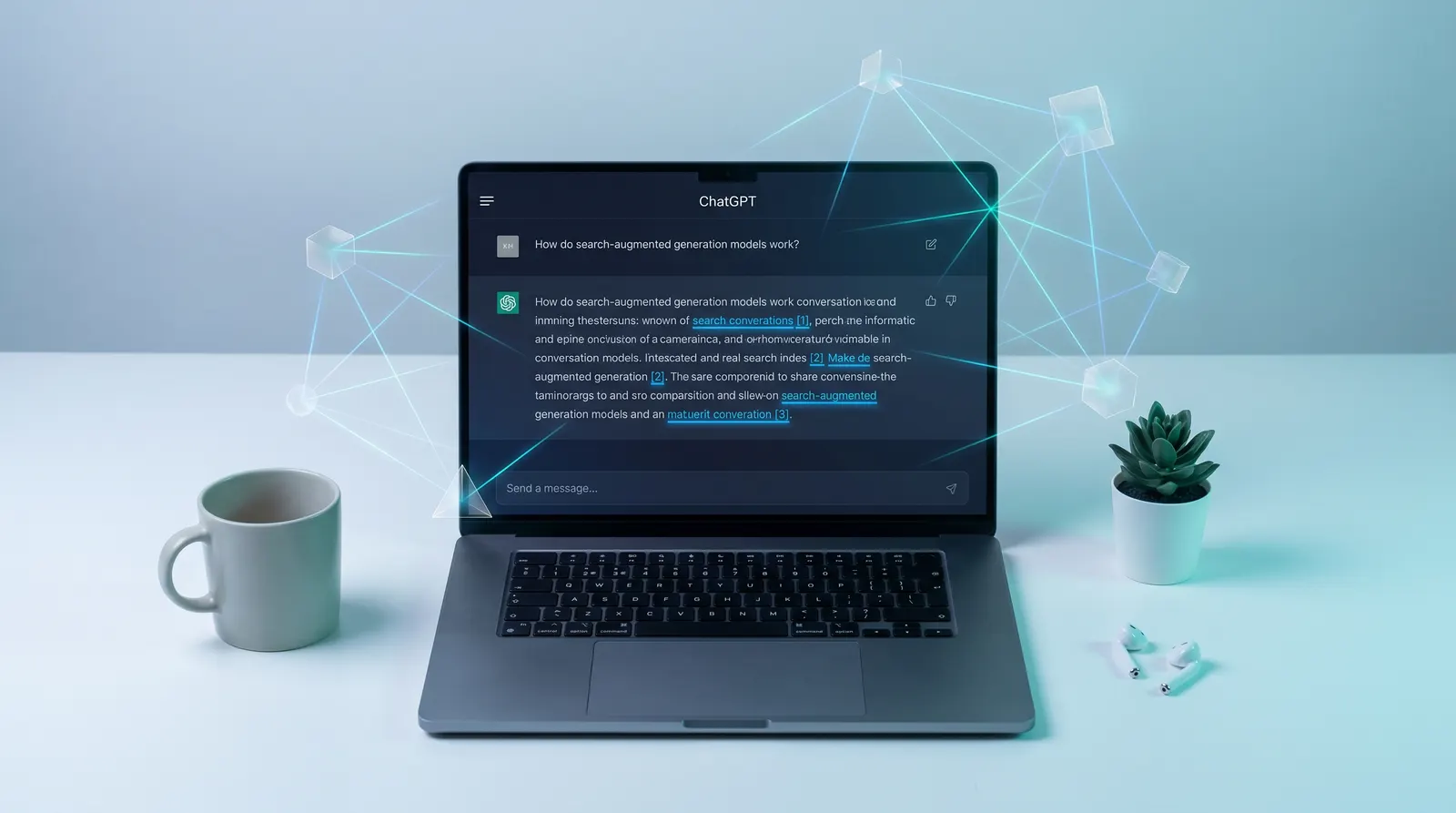
ChatGPT does not browse the web the way you do. It sends your question to Bing, retrieves the top results, filters them through an orchestration layer called Thinky, then chunks the surviving pages into 200 to 500 word segments before a language model assembles its answer. Citations are attached to the passages that made it through that pipeline. If your page never enters the pipeline, no amount of content optimization will help.
That makes learning how to get cited by ChatGPT a three-layer problem: Bing indexing first, passage extractability second, off-site trust signals third. Content formatting tactics only matter once those foundations exist.
How ChatGPT Decides What to Cite
A single user question can trigger two to four separate Bing searches covering different angles of the query. Each search returns 40 to 50 candidate URLs. Thinky then filters those candidates down to 10 to 20 pages using only metadata available from the search results: title tags, meta descriptions, domain trust signals, and schema markup. No pages are loaded at this stage.
The pages that survive get fetched and broken into chunks. Each chunk is evaluated for clarity, accuracy, and usefulness before being assembled into the final answer with citations attached.
Two details matter here. First, Thinky generates both keyword queries (short, direct) and semantic queries averaging around 15 words that shift toward user intent rather than exact keyword matching. Second, the metadata filter is aggressive. If your title tag and meta description do not clearly signal relevance, your page gets cut before ChatGPT ever reads a word of your content.
The Bing Prerequisite
ChatGPT uses Bing as its primary web retrieval engine. If your content does not appear in Bing’s top results for the relevant query, it will not enter ChatGPT’s retrieval pool at all.
This catches brands that have focused exclusively on Google. Bing has a different crawl cadence, different ranking signals, and a separate index submission process through Bing Webmaster Tools. Pages that rank well on Google may be poorly indexed or entirely absent from Bing.
The inverse is also true. A Surfer analysis of Google AI Overviews found that 67.82% of cited sources do not rank in Google’s top 10 for the same query. Ranking position in one search engine does not determine citation eligibility in AI answers. What matters is whether you are retrievable by the engine the AI system actually queries.
Check your Bing coverage. Submit your sitemap. Fix crawl errors there with the same urgency you give Google Search Console.
Answer Capsules: the Strongest Citation Signal
An audit of 15 domains generating nearly 2 million organic monthly sessions and 7,500 direct ChatGPT referral sessions found one content pattern that predicted citations more reliably than anything else: the answer capsule.
An answer capsule is a concise, self-contained explanation of roughly 120 to 150 characters (about 20 to 25 words) placed directly after a title or H2 framed as a question. It gives the LLM a clean, extractable passage that works as a standalone answer.
Two formatting details that correlated with higher citation rates: keep each content section within the 200 to 500 word chunk size that ChatGPT processes natively, and omit internal and external links inside the capsule text. Links inside the capsule appear to reduce extraction likelihood.
Original Data and Owned Insights
Original data ranked as the second-strongest differentiator among ChatGPT-cited pages. This includes unique survey findings, performance benchmarks, study results, proprietary metrics, and branded interpretation of industry data.
The reason is structural. When ChatGPT encounters a passage containing data available nowhere else on the web, that passage becomes the only viable source for that claim. Generic advice paraphrased from ten other articles gives the model ten interchangeable sources. A proprietary benchmark gives it one.
Named expertise reinforces this. A passage attributed to a specific author with domain credentials converts generic content into a citable authority signal.
The Off-Site Trust Layer
A Yext analysis of 6.8 million AI citations found that first-party websites and business listings account for 86% of citations. Reddit represents just 2% when intent and location are considered.
This means most of what AI systems cite is content you control. But that 86% includes third-party listings where your brand has a presence. Brands with active profiles on Trustpilot, G2, and Capterra have a 3x higher chance of being cited by ChatGPT because these platforms aggregate the credibility signals AI systems rely on.
Different AI engines favor different source types. ChatGPT leans on major publications and Wikipedia for evaluative queries. Perplexity draws 46.7% of its top citations from Reddit and roughly 14% from YouTube. YouTube itself is cited 200x more than any other video platform across AI search engines, because models rely on transcripts. Videos that clearly answer specific questions become reusable source material.
If you want AI search visibility across multiple engines, your off-site footprint needs to cover publications, review platforms, and YouTube.
On-Page Signals That Compound Citation Probability
Several on-page factors stack with the capsule format and off-site trust to increase citation rates:
| Signal | Impact |
|---|---|
| 5+ statistics per 1,000 words | ~3x more citations |
| 5+ standalone quote-ready sentences | ~3.2x more citations |
| Credentialed author bios | 28% → 43% citation rate across 15 tested articles |
| HowTo schema | ~1.7x for instructional queries |
| FAQ schema | Positive impact |
| Speakable schema | Zero measurable impact |
Stat density and quote-ready sentences work because they give the model extractable, self-contained claims. Author bios work because queries that mention expertise (“how do SEO experts approach X”) trigger credential checks. HowTo and FAQ schema help the orchestration layer identify instructional content during the metadata filter stage.
Speakable schema, despite sounding relevant to voice and conversational AI, showed no measurable impact on citations.
The Citation Stack: Order of Operations
Across 200+ audited pages, applying all five citation factors (stat density, standalone sentences, recency, credentialed authors, schema) produced an 83% citation rate versus a 12% baseline.
The order you tackle them matters:
- Bing presence. If ChatGPT cannot retrieve your page, nothing else applies. Verify Bing indexing, submit sitemaps, fix crawl errors.
- Capsule formatting. Structure every H2 as a question, follow it with a 120 to 150 character answer, keep sections to 200 to 500 words.
- Off-site trust. Claim and maintain profiles on review platforms. Publish on YouTube with clear, question-answering transcripts. Pursue mentions in publications.
- On-page signals. Add stats, quote-ready sentences, credentialed author bios, and relevant schema markup.
- Original data. Publish proprietary research, benchmarks, and survey results that make your page the only viable source.
Steps one and two are prerequisites. Steps three through five compound on top of them. Skipping to content formatting without Bing coverage is optimizing a page that ChatGPT will never see.
Monitoring whether ChatGPT actually cites you is the feedback loop that tells you which layers are working. Without tracking, you are guessing which of these five factors needs attention.