
In March 2026, Reyourrun’s pages pulled 14,515 impressions from Google. In June they pulled 114,677. Same domain, same product, 7.9 times the reach in three months. Clicks moved with it, from 335 in March to 1,843 in June.
Go back further and the arc is steeper. In March 2025, Re.’s first tracked month on Google, the site pulled 218 impressions. Its entire first year totalled 49,782. June 2026 alone beat that, and the first twelve days of July beat it again.
Reyourrun is an Australian running-sunglasses brand, founded by Tim. Re. has used Fokal since its first version. A year ago its articles were invisible in AI search. Today six of them are cited as sources by ChatGPT, Perplexity and Google’s AI. Here is the data behind that, where every number comes from and when it was pulled, and exactly what we shipped in between.
The numbers, from Re.’s own Search Console
These are Google Search Console figures for reyourrun.com.au, pulled 15 July 2026 with data through 12 July.
| Month | Impressions | Clicks |
|---|---|---|
| March 2025 (first tracked month) | 218 | 24 |
| March 2025 to February 2026 (year one, total) | 49,782 | 2,175 |
| March 2026 | 14,515 | 335 |
| April 2026 | 25,662 | 604 |
| May 2026 | 55,410 | 1,003 |
| June 2026 | 114,677 | 1,843 |
| 1-12 July 2026 | 63,725 | 874 |
Impressions grew 7.9x from March to June. Clicks grew 5.5x over the same window. July is running ahead of June: 63,725 impressions in the first twelve days is a faster daily pace than June managed across the whole month.
Search Console counts what Google actually served, so this is Google’s own view of how often Re. showed up and how often people clicked through. It is the anchor for everything below.
“I check Fokal just to watch the line climb. March was 14,000 impressions. June was 114,000. I haven’t written a word of it.”
Tim, founder of Re.
What Fokal shipped
Between 11 April and 14 July 2026, Re. published 56 articles. They cluster around the questions its buyers actually type: trail running sunglasses, anti-fog lenses, sunglasses for men, and head-to-head comparisons against the brands shoppers already know.
A few of the pages that now carry the load:
- Best Running Sunglasses for Men in 2026
- Best Sunglasses for Trail Running in Australia
- Re.glide: Infinity Running Sunglasses, the product explainer that answers the anti-fog question directly
- Re. vs Goodr, a comparison page that lays out price, lens material and lens technology side by side
The blog is now where the traffic lives. Across Re.’s top 25 pages, /blogs/ articles account for 86.5% of impressions, or 76,425 of 88,399, over the 28 days to 15 July 2026. The product and category pages still matter, but the writing is what Google is showing.
Six articles the AI engines cite
Ranking in Google is one signal. Getting pulled into an AI answer is another, and it is the harder one.
A visibility probe on 15 July 2026 found six distinct reyourrun.com.au articles cited as sources by AI engines, across ChatGPT, Perplexity and Google’s AI. The outcomes report from 6 July 2026 counted the same six independently. Of the six category searches in the probe, Re.’s articles were cited as sources in four:
- best trail running sunglasses for men: Google’s AI cites two Re. articles
- best anti-fog running sunglasses: ChatGPT and Google both cite Re.
- best sunglasses for trail running australia: Google cites Re.
- re vs goodr: Perplexity and Google pull from the comparison page Re. published
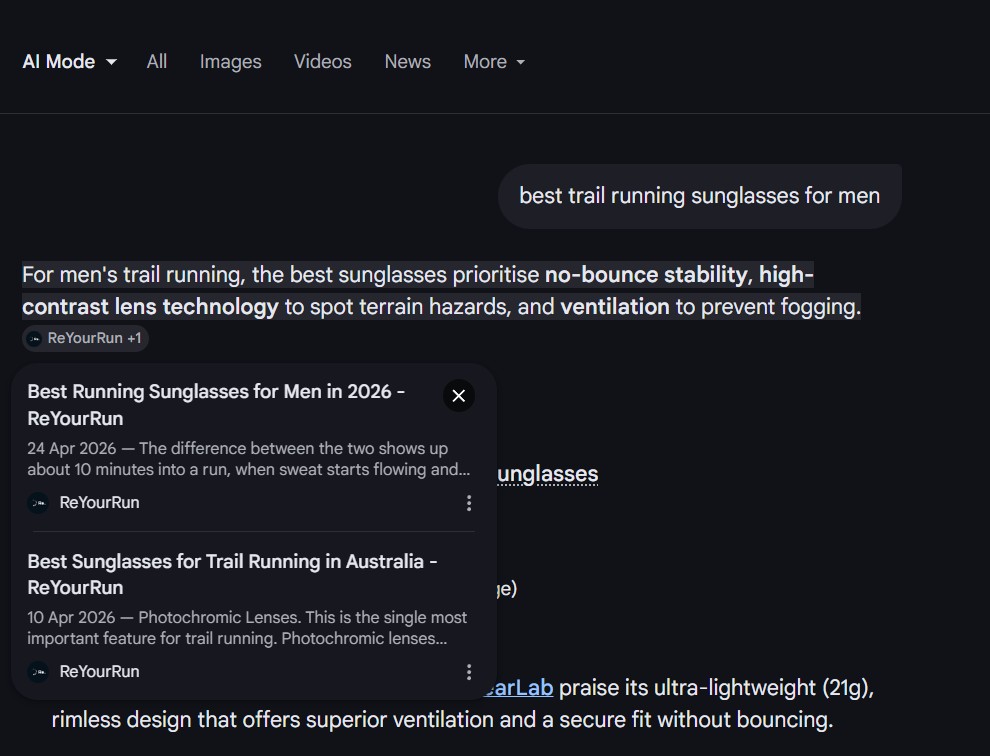
Google’s AI Mode cites two Re. articles as sources for “best trail running sunglasses for men”: the men’s guide and the Australia trail guide.
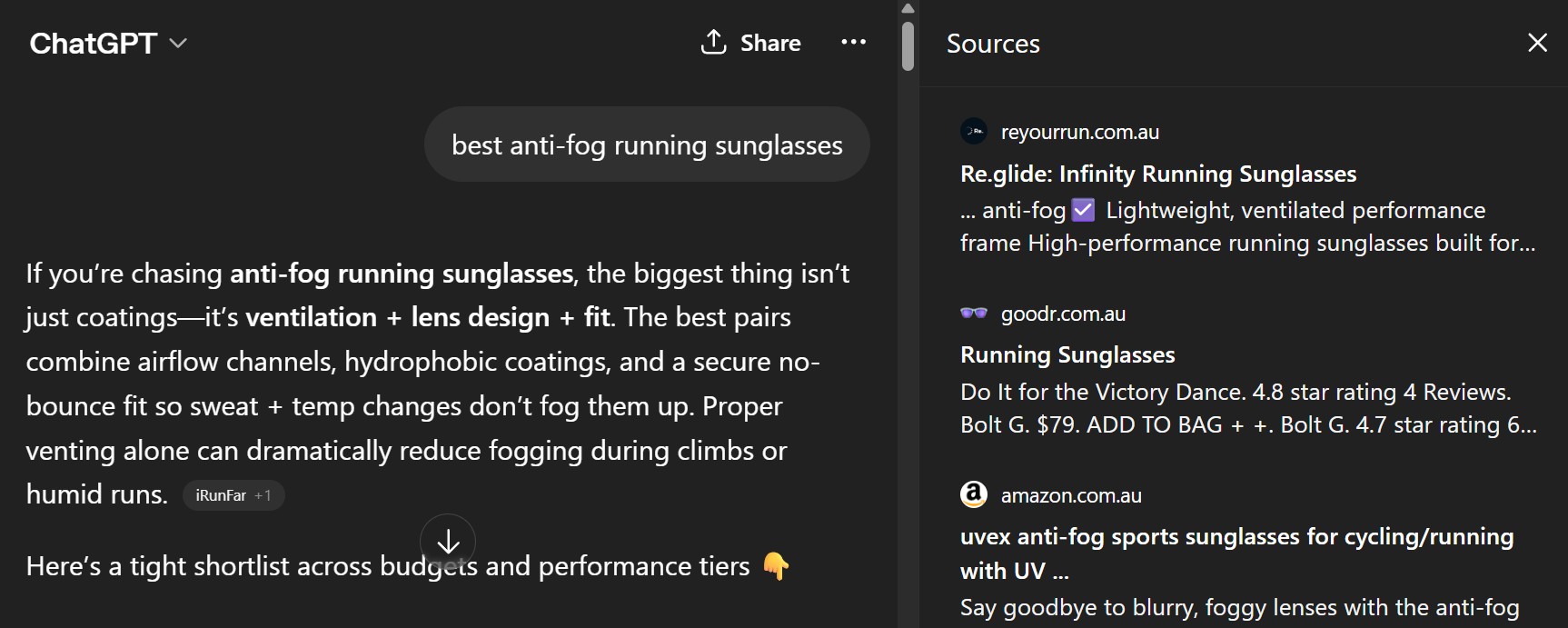
ChatGPT’s sources for “best anti-fog running sunglasses” include Re.’s Re.glide article. The citation is of the article, the page Re. published, which is what the probe measures.
What these numbers do and don’t say
The Search Console and article-citation figures above are the load-bearing ones. Two more come from Google Analytics, and they carry an earlier date.
The GA pull is from 8 July 2026. It shows blog sessions growing from 50 to 1,976, and organic search as the best-converting revenue channel of the ones Re. tracks. We are naming the date because that pull is a week older than the Search Console numbers, and honest reporting means saying so rather than implying everything was measured on the same day.
On revenue: the attribution is brand and product organic search, not per-article. Google Analytics tells us organic search converts better than the other channels Re. runs. It does not tell us that a specific trail-running article drove a specific sale. Anyone who claims that level of attribution from standard analytics is guessing. We would rather show you what the tools can actually prove.
The citations are of Re.’s articles as sources. That is a real, checkable thing: an AI engine reached for a page Re. wrote when it built its answer. It is a different claim from a chatbot naming Re. as a brand, and we only report what the probe returns.