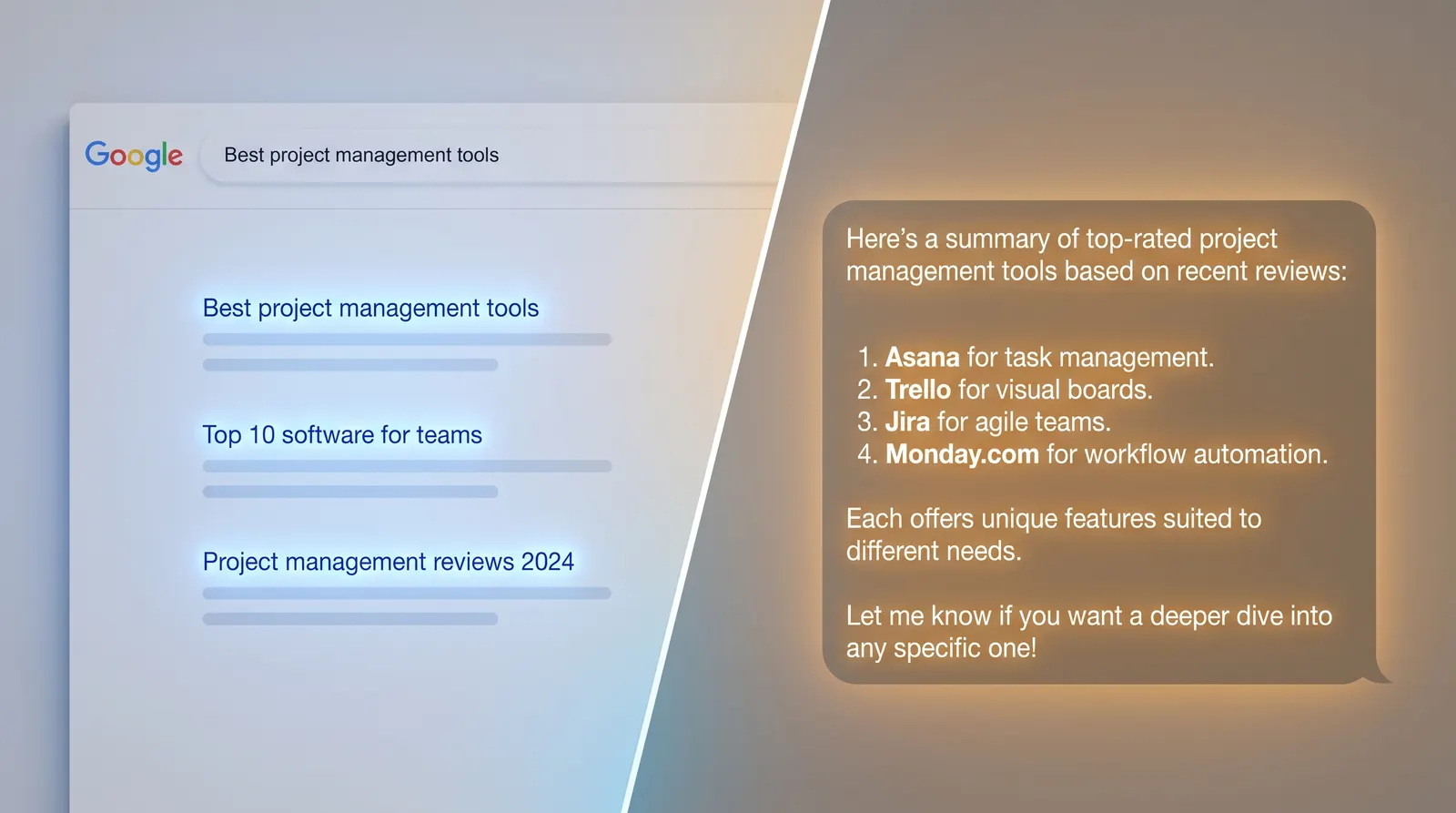
You already know how SEO works. You write content, build links, optimize pages, and try to rank on Google. AEO is what happens when the person never sees Google’s results page at all.
They ask ChatGPT. They ask Perplexity. They get a direct answer with two or three brand names in it. If your brand isn’t one of them, that customer is gone before you ever had a chance to compete.
That’s the core difference between AEO and SEO. And understanding it changes how you think about your entire content strategy.
What is AEO?
Answer engine optimization (AEO) is the practice of getting your brand cited inside AI-generated answers. When someone asks ChatGPT “what’s the best project management tool for remote teams?” or Perplexity “which CRM integrates with Shopify?”, the AI reads hundreds of sources and generates a single response. AEO determines whether your brand makes the cut.
The term “answer engine” refers to any AI tool that gives direct answers instead of a list of links. ChatGPT, Perplexity, Google AI Overviews, and Gemini all qualify.
What is SEO?
Search engine optimization (SEO) is the practice of ranking your pages in traditional search results. Google processes billions of searches daily, and SEO is how you show up when someone types a query and browses the results.
SEO has been around for over two decades. The fundamentals haven’t changed: create useful content, earn backlinks, build a fast and well-structured site, and match what searchers are looking for. What has changed is the landscape around it.
AEO vs SEO: the key differences
The goals are different. The signals are different. The way users interact with results is different. Here’s how they compare across the dimensions that matter.
| Dimension | SEO | AEO |
|---|---|---|
| Goal | Rank in search results | Get cited in AI answers |
| User behavior | Browses a list of results, clicks through | Reads a single generated answer |
| Primary signals | Backlinks, keywords, page speed, authority | Third-party mentions, content structure, entity reputation |
| Content format | Optimized for click-through and on-page time | Optimized for extraction and citation |
| Success metric | Rankings, organic traffic, CTR | Brand mentions, citation frequency, visibility across AI engines |
| Discovery surface | Google, Bing search results | ChatGPT, Perplexity, Google AI Overviews, Gemini |
| Timeline | 20+ years of established best practices | Emerging, rapidly evolving |
How AI engines pick sources differently than Google
This is the part that trips people up. Google ranks pages. AI engines select sources. Those are fundamentally different processes.
Google evaluates your page against other pages and assigns a position. If you’re #1, everyone sees you. AI engines evaluate hundreds of pages and synthesize one answer. Your page might be one of the sources behind that answer, but the user never sees your URL unless the engine decides to cite you.
The three major AI surfaces weight signals differently:
- ChatGPT leans heavily on what other sites say about you. Third-party reviews, Reddit discussions, comparison articles, and Wikipedia mentions carry more weight than your own marketing pages.
- Perplexity is the most citation-transparent engine. It links every claim to a source and favors recent, well-structured content that directly answers the query.
- Google AI Overviews build on Google’s existing search index. Pages that already rank organically have a better shot at appearing in the AI Overview. Traditional SEO still matters here.
The takeaway: your SEO rankings feed into some AI engines (especially Google AI Overviews), but they’re not enough on their own. AEO adds the layer that gets you cited when the answer is generated.
Where AEO and SEO overlap
Despite the differences, these two disciplines share a lot of DNA. If you’re doing SEO well, you already have a head start on AEO.
Content quality matters in both. Thin, generic content doesn’t rank on Google and doesn’t get cited by AI. Both reward depth, accuracy, and usefulness.
Structure matters in both. Clear headings, logical page flow, and schema markup help Google understand your page and help AI engines extract answers from it.
Authority matters in both. Backlinks signal trust to Google. Third-party mentions and citations signal trust to AI engines. The sources are different, but the principle is the same: other sites vouching for you.
Freshness matters in both. Google favors updated content for time-sensitive queries. AI engines (especially Perplexity) heavily weight recency when selecting sources.
The overlap is real, which is why the answer to “should I do SEO or AEO?” is always “both.” They reinforce each other.
Where AEO requires something different
Some AEO tactics don’t exist in traditional SEO. These are the areas where you need to add new work.
1. Optimize for entity reputation, not just keywords
SEO is keyword-driven. You research what people search for, then create content targeting those terms. AEO is entity-driven. AI engines build a model of what your brand is, what it does, and what others say about it.
This means your presence across the web matters more than any single page. Reviews on G2. Discussions on Reddit. Mentions in industry publications. Comparison articles that list you alongside competitors. These all feed the AI’s understanding of your brand.
2. Structure content for extraction
In SEO, you optimize for click-through. A compelling title, a strong meta description, content that keeps people on the page. In AEO, you optimize for extraction. The AI needs to pull a clean, accurate answer from your content and attribute it to you.
That means:
- Lead sections with direct answers to questions
- Use clear, descriptive headings (not clever or vague ones)
- Keep paragraphs focused on a single point
- Include data, statistics, and specific claims the AI can cite
3. Build third-party visibility
In SEO, backlinks from authoritative sites boost your rankings. In AEO, third-party mentions shape how AI engines perceive your brand. The distinction matters: a backlink helps your page rank, but a mention in a review article, a Reddit thread, or a comparison guide helps your brand get recommended.
If ChatGPT is asked “what are the best tools for X?” and your brand appears in multiple comparison articles, review sites, and community discussions, you’re far more likely to be included in the answer. Our link building for AI SEO guide goes deeper on this.
4. Monitor AI engines directly
SEO measurement is mature. You check rankings, traffic, and conversions in Google Search Console and analytics tools. AEO measurement is newer and requires checking your visibility across each AI engine individually.
That means running queries in ChatGPT, Perplexity, and Google AI Overviews to see whether your brand shows up. It means tracking mention type (are you recommended, listed, or just mentioned in passing?), and watching how your visibility changes over time. Tools that handle AI visibility tracking do this continuously so you don’t have to run checks manually.
What about GEO?
You’ll also see the term generative engine optimization (GEO). In practice, AEO and GEO overlap heavily. AEO emphasizes answer engines specifically. GEO is a broader umbrella that covers any generative AI search surface, including Google AI Overviews.
If you’re optimizing for ChatGPT and Perplexity citations, you’re doing AEO. If you’re also optimizing for Google AI Overviews and Gemini, you’re doing GEO. Most brands should treat them as the same initiative with the same playbook.
For a deeper comparison, see our generative engine optimization guide.
A practical checklist: doing both
You don’t choose between AEO and SEO. You layer AEO on top of the SEO foundation you already have. Here’s what that looks like in practice.
SEO foundation (keep doing this):
- Keyword research and content mapping
- Technical SEO (site speed, crawlability, mobile-friendliness)
- Internal linking between related pages
- Earning backlinks from authoritative sites
- Keeping content updated and accurate
AEO layer (add this):
- Answer questions directly in your content, especially in the first paragraph under each heading
- Add FAQ schema to pages targeting question-based queries
- Get your brand mentioned on third-party sites (reviews, comparisons, industry articles, Reddit, community forums)
- Add structured data (schema markup) so AI engines can parse your content
- Check that AI crawlers can access your site (review your robots.txt for GPTBot, PerplexityBot, and others, covered in our llms.txt guide)
- Monitor your brand’s AI visibility across ChatGPT, Perplexity, and Google AI Overviews
- Keep content genuinely fresh, not just updated dates, but new data, examples, and insights
Quick wins to start today:
- Pick your five most important product or service pages
- Add a direct, concise answer to the main question each page addresses in the first paragraph
- Add FAQ schema with 3-5 questions per page
- Search for your brand name in ChatGPT and Perplexity to see where you currently stand
- Identify the top comparison and review articles in your space and work toward getting included
The bottom line
SEO gets you found on Google. AEO gets you cited by the AI that increasingly answers the question before anyone clicks a search result.
They’re not competing strategies. SEO builds the foundation: the rankings, the authority, the content library that AI engines draw from. AEO ensures that foundation translates into visibility in the new surfaces where buying decisions happen.
The brands winning right now aren’t choosing one over the other. They’re treating AEO as the natural next layer on top of solid SEO, because that’s exactly what it is.
If you’re starting from scratch, start with SEO. If you already have SEO in place, answer engine optimization is your next move. And if you want to see where you stand right now, check how AI engines see your brand today.