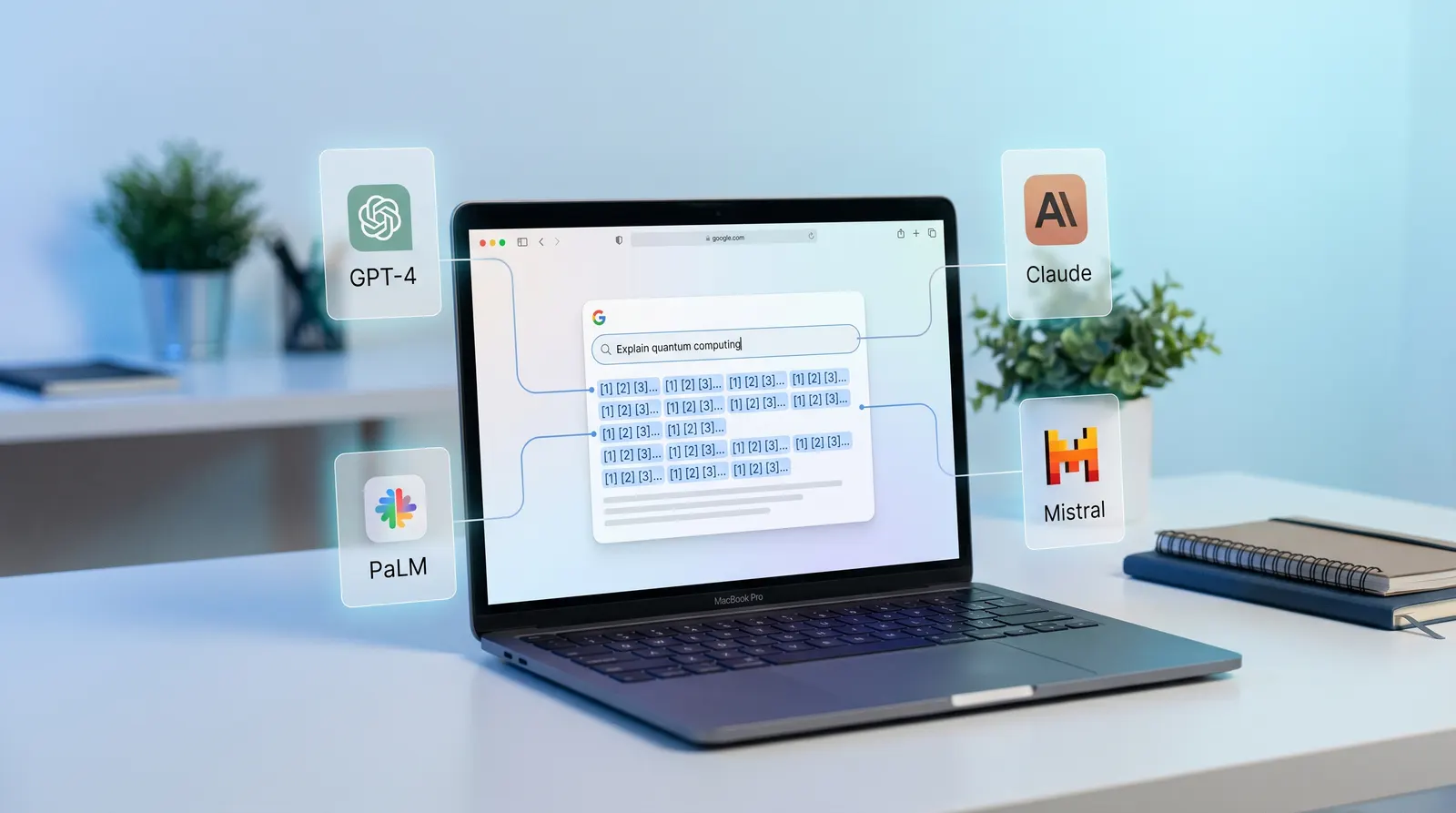
AI search optimization is the practice of making your content citable by AI-powered search engines: ChatGPT, Perplexity, Google AI Overviews, and Gemini. Where traditional SEO chases a position in ten blue links, AI search optimization chases the quote, the citation, the brand mention inside a generated answer. These are not the same goal, and the tactics diverge in important ways.
The stakes are real. ChatGPT has grown into one of the most widely used search-adjacent tools on the web. Google AI Overviews now appear on roughly 16% of searches in the US, and that share keeps shifting as Google expands the feature into commercial queries. Research from Semrush found that AI search visitors convert at 4.4 times the rate of organic search visitors, which makes a citation in an AI answer worth more than a mid-page organic listing. If your brand is absent from these answers, you are invisible to a growing share of high-intent searchers.
AI search optimization is not a replacement for SEO. It is the layer on top of it. The AI SEO pillar covers the full picture. This guide goes deep on the optimization specifics.
What makes AI search different from traditional search
AI search engines do not return a list of URLs and let the user decide. They generate a synthesized answer and cite a small number of sources. The output is a paragraph or a table, not ten links. That changes the competitive dynamic entirely.
In traditional search, ten brands can share a page-one result. In an AI answer, two or three brands get named and the rest do not exist. The winner-takes-most nature of AI citations is why optimization matters so much, and why showing up in one AI answer can disproportionately influence how AI engines think about your brand across all queries.
The underlying engines differ in retrieval approach. Google AI Overviews draw from Google’s own search index, which means pages already ranking in traditional search have a structural advantage. ChatGPT uses a combination of training data and live web search via OAI-SearchBot and Bing’s index. Perplexity pulls from multiple search APIs and its own index, typically citing five to ten sources per answer. Claude uses Brave Search results for web-connected responses. Each pipeline has its own quirks, but the content signals they respond to overlap significantly.
The dual goal: rank on Google and get cited in AI answers
These two goals reinforce each other more than most SEO guides acknowledge. Pages with strong traditional rankings are significantly more likely to be cited in AI answers, because AI engines retrieve from the same indexes they use for web search. But the relationship is not one-directional.
Content structured for AI citation, which means direct answers at the top of each section, specific named entities, and verifiable claims, also tends to rank better in traditional search. Google’s own ranking systems increasingly reward content that directly answers a query without making the reader work for it.
The practical implication: you do not need two separate content strategies. You need one strategy built around direct-answer content that serves both Google’s ranking systems and AI engines’ citation preferences. Semrush research found that pages with quotes and statistics had 30-40% higher visibility in AI responses compared to content without them. That specificity signal applies to traditional search ranking too.
For tracking how well you are appearing across both surfaces, AI visibility tracking is the place to start.
How AI engines select sources
Understanding the retrieval process is the foundation of any AI search optimization strategy. The process has four stages.
Query fan-out. AI engines reformulate the user’s question into multiple sub-queries. A single prompt generates several internal searches covering different angles of the intent. Content that addresses the predictable sub-topics of a query has more surface area for citation.
Candidate retrieval. The engine pulls candidate pages from its index. Pages not indexed do not exist to the AI engine, regardless of how well the content is written. This is why technical accessibility is non-negotiable.
Content extraction. The model scans retrieved pages for relevant passages. It favors clearly structured content with direct answers in the first paragraph of each section, specific data points with named sources, and well-defined entities. Content buried in JavaScript or hidden behind authentication gets skipped entirely.
Citation decision. The model decides which sources to quote or reference. It weighs factual specificity, source authority, recency, and cross-source consensus. A claim that appears on multiple credible, independent sources is more likely to be cited than one that only appears on your own site.
Seven optimization tactics that move the needle
Make AI crawlers welcome
The major AI engines use their own crawlers: OAI-SearchBot and GPTBot for ChatGPT, PerplexityBot, ClaudeBot, and CCBot for others. Unlike Googlebot, these crawlers cannot execute JavaScript. If your content renders client-side, AI crawlers see an empty page.
Check your robots.txt to confirm you are not blocking these user agents. Verify that your key content, including your main body copy and schema markup, is in the raw HTML response and not injected via JavaScript. Schema added through Google Tag Manager is invisible to AI crawlers. Our llms.txt guide covers crawler access specifically.
For a broader readiness check, Arobis AI Visibility Checker audits crawler access alongside structured data, semantic structure, content and entity signals, llms.txt, and technical health.
Structure every section for extraction
AI models parse content looking for discrete, citable passages. The structure that makes this easy is a direct answer in the first 40-60 words of each section, followed by supporting detail. Questions framed as headings align with how AI engines reformulate queries internally. Lists and tables are easier to extract verbatim than long prose paragraphs.
One idea per paragraph, each one complete enough to stand alone as a citation. This is not just for AI engines. It is the same structure that earns featured snippets in Google.
Build entity authority off your site
AI engines do not only evaluate individual pages. They assess your brand as an entity across the web. This is where AI search optimization diverges most from traditional SEO.
Entity authority comes from consistent brand information across your site, social profiles, and directory listings; mentions (not just links) on authoritative third-party sites, industry publications, and forums; and a presence on platforms AI engines actively crawl, including Reddit, LinkedIn, and niche-specific directories. Unlinked brand mentions carry real weight in how AI engines model your authority on a topic. Our link building guide covers the outreach tactics that feed this.
Add the right structured data
Schema markup gives AI engines explicit signals about what your content covers. The highest-priority types for AI search:
- Article or BlogPosting with author, datePublished, and dateModified
- FAQPage for question-driven content
- HowTo for step-by-step guides
- Organization on your homepage and about page
Implement schema as server-rendered JSON-LD in your page’s <head>. Dynamically injected schema is invisible to AI crawlers. Our schema markup guide has implementation examples.
Write with specificity
Generic advice gets synthesized from multiple sources without attribution. Specific claims earn the citation. A sentence like “brands that publish original research see more AI citations” is skippable. A sentence like “pages with quotes and statistics had 30-40% higher visibility in AI responses” (Semrush, 2025) is citable.
What gets cited: original statistics with methodology, named frameworks, specific pricing or benchmark numbers, expert quotes with attribution, and step-by-step processes with concrete examples. What gets skipped: hedged recommendations, vague best practices, and content that restates what every other page already says. The AI content optimization guide goes deeper on structuring content for AI citation.
Understand engine-specific differences
Google AI Overviews draw from pages already in the top 10, which makes topical authority and comprehensive coverage the primary lever. They appear on roughly 16% of US queries and are expanding into commercial intent. Our AI Overview optimization guide covers the specifics.
ChatGPT Search retrieves from Bing’s index, so Bing indexation matters here in a way it does not for traditional Google SEO. Recency is a strong signal. Freshly updated content is preferred over equally good but older content.
Perplexity cites more sources per answer than other engines, typically five to ten, which means it is possible to appear without being the definitive source. Its index includes academic and research content, so technical credibility helps.
Monitor AI visibility as a metric
You cannot optimize what you do not measure. For each priority query, run it directly in ChatGPT, Perplexity, and Google to check for AI Overviews. Note whether your brand appears, whether you are cited with a link, and which competitors show up instead.
AI search results shift faster than traditional rankings. Monthly monitoring at minimum, weekly for high-value queries. Fokal automates this across engines so you can track citation rate, share of voice, and competitor mentions over time rather than running manual spot checks. See the monitor brand in AI search guide for how to set this up.
What not to do
A few common moves that do not translate from traditional SEO and some that actively hurt.
Keyword stuffing. AI models evaluate semantic relevance. Repeating phrases unnaturally makes content harder to extract, not easier.
Thin content at scale. Publishing dozens of shallow pages to cover keyword variations is counterproductive. AI engines prefer comprehensive coverage on fewer authoritative pages.
Blocking AI crawlers. Some sites block AI crawlers hoping to protect their content. This guarantees you will not be cited. If visibility in AI search matters to your business, you need to allow access.
Treating AI SEO as separate from SEO. AI search optimization builds on top of SEO fundamentals. Sites with strong technical foundations and high-quality backlink profiles have a structural advantage in AI citations. Generative engine optimization and traditional SEO compound together.
How to prioritize when you’re starting out
If you are approaching this for the first time, work in this order.
- Audit crawler access. Check robots.txt for blocked AI user agents. Verify your core content is in raw HTML, not rendered client-side.
- Pick five high-value queries. Run them across ChatGPT, Perplexity, and Google. Document which brands get cited and why.
- Restructure one page. Take a strong-performing page and rewrite each section to lead with a 40-60 word direct answer. Add at least one specific, sourced statistic.
- Check back in 30 days. Re-run the same queries. AI search results shift faster than organic rankings, so signal shows up quickly.
The broader strategy playbook, including how to build topical authority and which content types earn the most AI citations, lives in the AI SEO strategy guide.