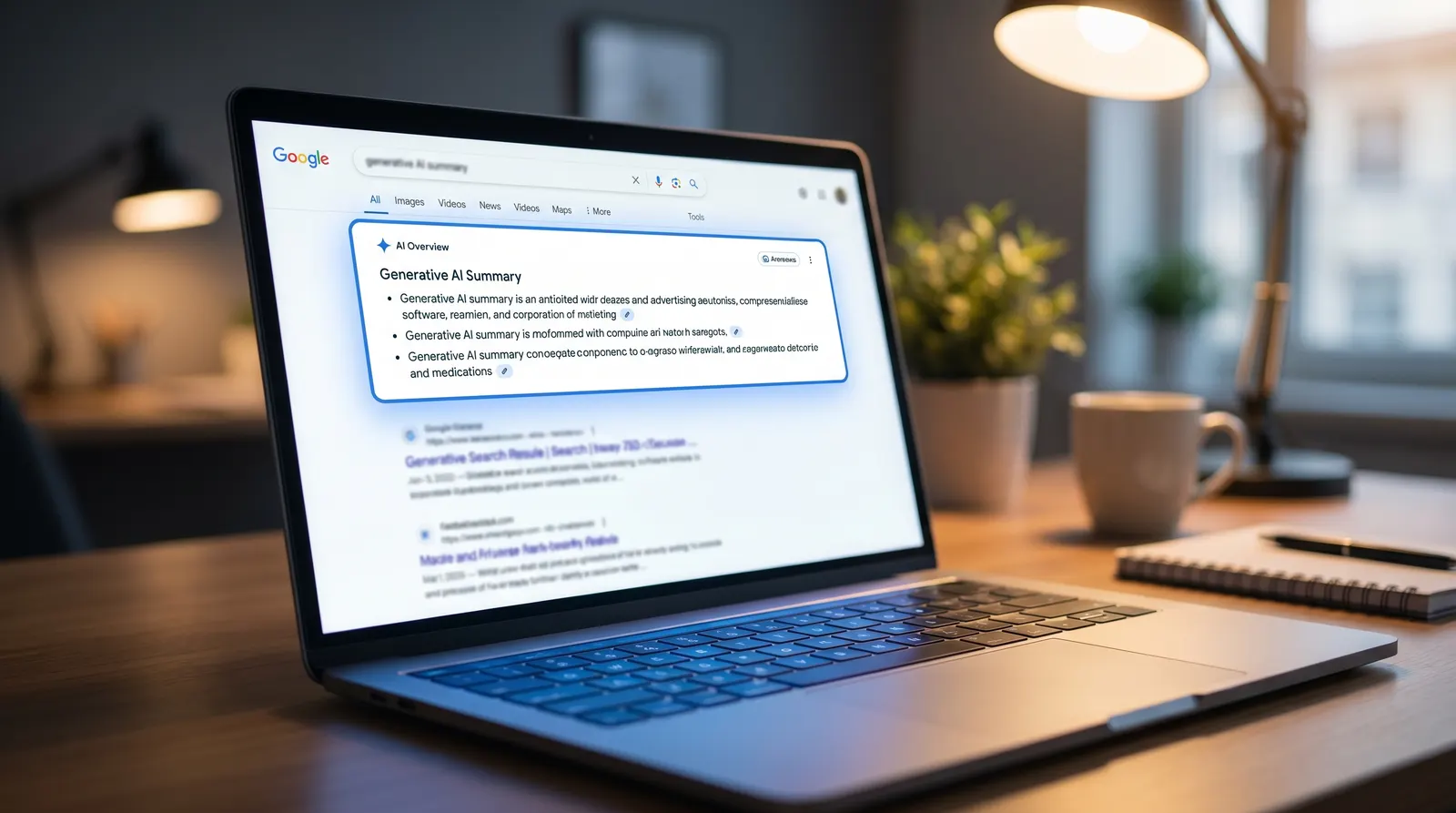
Google now answers millions of searches with an AI-generated summary before the first organic result. If your content isn’t being pulled into those answers, you’re losing visibility to competitors who are. AI overview optimization is how you fix that.
What are Google AI Overviews?
AI Overviews are AI-generated answer boxes that appear at the top of Google search results. Powered by Google’s Gemini models, they pull information from multiple web pages and synthesize a single response with source citations.
Unlike featured snippets, which quote one source, AI Overviews blend information from several pages. They cite those sources with clickable links, giving each cited page a visibility boost even when users don’t click through.
AI Overviews now appear on roughly 17-30% of U.S. searches. That number is growing. Google has rolled them out across 200+ countries and 40+ languages. If you’re doing SEO in 2026, you can’t ignore them.
Why AI overview optimization matters
The data is clear. When an AI Overview appears, users click traditional organic links about 8% of the time, compared to 15% without one (Pew Research). That’s a significant drop in organic click-through rates.
But the flip side is powerful. Being cited in an AI Overview puts your brand name and link above every organic result. You’re not just ranking. You’re being recommended by Google’s AI as a trusted source.
There’s also a shift in what triggers AI Overviews. In late 2024, 89% of AI Overviews appeared on informational queries. By late 2025, that dropped to 57%. The rest? Commercial and transactional queries. Product comparisons, pricing questions, “best of” lists. The queries that drive revenue are increasingly getting AI answers.
This means AI overview optimization isn’t just about informational content anymore. Your product pages, comparison guides, and pricing pages need to be optimized too.
What triggers an AI Overview?
Not every search gets one. Understanding what triggers AI Overviews helps you target the right queries.
Query types that commonly trigger AI Overviews:
- Questions starting with “what,” “how,” “why,” “which”
- Long-tail queries with specific intent (“best CRM for small teams under $50/month”)
- Comparison queries (“X vs Y,” “alternative to Z”)
- Multi-step process queries (“how to set up email authentication”)
- Definition and explainer queries
Query types that rarely trigger them:
- Navigational queries (searching for a specific brand or website)
- Very simple factual lookups (handled by knowledge panels instead)
- Highly local queries (handled by map packs)
Google uses a process called “query fan-out,” where it runs multiple related searches behind the scenes to build a comprehensive answer. This means your content can get pulled into AI Overviews even for queries you didn’t explicitly target, as long as your content answers a related sub-question.
How to optimize for AI Overviews
1. Answer questions directly and clearly
AI models are looking for clear, concise answers. When your page targets a question, answer it within the first few sentences of the relevant section. Don’t bury the answer under three paragraphs of context.
Use this structure: direct answer first, then supporting detail. Think of every H2 as a question your reader is asking, and make the first 2-3 sentences a standalone answer to that question.
2. Structure content for AI parsing
Google’s AI needs to extract clean information from your page. Make that easy.
- Use descriptive H2 and H3 headings that mirror real search queries
- Break complex information into numbered lists or bullet points
- Use tables for comparisons, specs, or data
- Keep paragraphs short (2-4 sentences)
- Include a clear definition near the top when targeting “what is” queries
Pages that are well-structured rank better in traditional search and get cited more in AI Overviews. Both systems reward clarity.
3. Add schema markup
Schema markup helps Google understand what your content is about. For AI Overview optimization, the most valuable types are:
- FAQPage for pages with question-and-answer sections
- HowTo for step-by-step guides and tutorials
- Article with author, datePublished, and dateModified
- Organization for your brand’s entity information
- Review and Product for commercial pages
You don’t need all of these on every page. Match the schema to the content type. An FAQ page gets FAQPage schema. A tutorial gets HowTo. The goal is giving Google structured signals about what your page contains.
4. Build topical authority
AI Overviews favor sources that demonstrate expertise across a topic, not just on a single page. Google’s AI is more likely to cite you if you have a cluster of related content that covers a subject thoroughly.
This means:
- Create a pillar page on your core topic with supporting articles on subtopics
- Interlink these pages with descriptive anchor text
- Cover adjacent questions your audience is asking
- Update content regularly with fresh data and insights
A site with ten well-linked articles on AI search optimization is more likely to get cited than a site with one standalone post, even if that post is excellent.
5. Include original data and expert perspectives
Generic advice gets outranked by content with substance. AI models are trained to identify and prioritize original information.
Include things like:
- Your own data, benchmarks, or case studies
- Expert quotes with clear attribution
- Specific numbers with sources
- Real examples from your experience
Content that says “structured data improves AI visibility” is weaker than content that says “we added FAQPage schema to 12 client sites and saw AI Overview citations increase by 34% within 60 days.” Specificity wins.
6. Ensure crawlability and indexability
None of this works if Google can’t access your content. Check these basics:
- No robots.txt blocks preventing Googlebot from crawling key pages
- No noindex tags on pages you want in AI Overviews
- Clean internal linking so Google discovers your content
- Fast page load times (Core Web Vitals in the green)
- Mobile-friendly design (Google crawls mobile-first)
Run a technical audit periodically. A single misconfigured robots.txt rule can keep your entire site out of AI Overviews. Our llms.txt guide covers related crawler-access patterns for AI engines beyond Google.
7. Earn backlinks and brand mentions
Authority signals still matter. Google’s AI models pull from sources they consider trustworthy, and backlinks remain a core trust signal.
Focus on:
- Getting cited in industry publications and roundups
- Building relationships with journalists and editors in your space
- Creating content worth referencing (original research, data, frameworks)
- Earning brand mentions even without links (AI models read these too)
This is the same link building that powers traditional SEO. The difference is that AI Overviews seem to weight source diversity. Being mentioned across many different sites matters more than having a few high-DA links. Our link building for AI SEO guide has more on this.
How to measure AI Overview performance
You can’t optimize what you can’t measure. Here’s how to track your AI Overview visibility:
Google Search Console: Look for queries where your impressions are high but clicks are lower than expected. This can indicate an AI Overview is capturing attention above your organic result. GSC doesn’t isolate AI Overview traffic yet, but impression and CTR patterns give clues.
AI visibility tracking tools: Tools like Fokal let you monitor whether your brand appears in AI-generated answers across Google AI Overviews, ChatGPT, and Perplexity. Track specific queries over time to see if your optimization efforts are working. Learn more about AI visibility tracking.
Manual spot checks: Search your target queries in Google and note whether an AI Overview appears, whether you’re cited, and who else is cited. Do this regularly for your top 10-20 priority queries.
AI Overviews vs. ChatGPT and Perplexity
AI Overviews are just one piece of the AI search puzzle. ChatGPT and Perplexity also generate answers that cite web sources, but they work differently.
- AI Overviews use Google’s search index, so traditional SEO directly influences visibility
- ChatGPT relies on training data plus real-time browsing, and heavily weights third-party mentions over first-party content
- Perplexity is the most citation-transparent, linking every claim to a source
Optimizing for AI Overviews gives you a head start on the other engines because the fundamentals overlap: clear structure, topical authority, schema markup, and content that directly answers questions. But each engine has its nuances. Read our guides on ChatGPT SEO and answer engine optimization for engine-specific tactics.
Getting started
Pick five queries where you want to appear in AI Overviews. Check whether they currently trigger one. Then audit your existing content against the seven optimization steps above. Fix the gaps, track your visibility, and iterate.
AI Overviews are not going away. They’re expanding. The brands that optimize for them now will own a visibility channel their competitors haven’t figured out yet.